
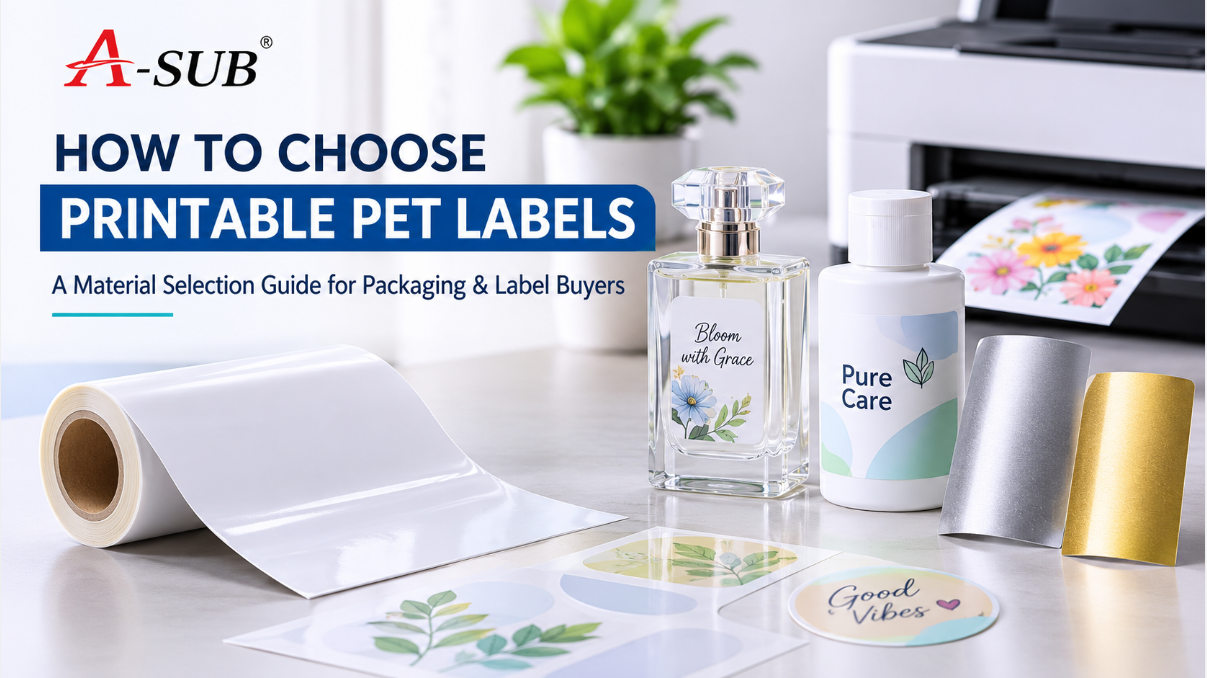

Product labels do more than display a brand name or product information. Their material and finish can influence packaging appearance, printing results, and the overall impression of a finished product.
For wholesalers, packaging suppliers, and printing businesses, choosing the right printable PET labels means balancing appearance, printer compatibility, material specifications, and application requirements.
PET labels are available in different finishes, including transparent, glossy white, silver, gold, and decorative textures. But how should buyers compare these options, and what details should they confirm before placing a bulk order?
This article explains the key selection factors and introduces the PET label options available from A-SUB.
1. What Are Printable PET Labels?
Printable PET labels are self-adhesive labels made with a polyethylene terephthalate (PET) film facestock. Compared with paper-based labels, PET film labels offer a different material structure and a wider range of visual finishes.
They are commonly considered for product packaging, container labeling, decorative identification, and applications where a film-based label is preferred.
For commercial buyers, PET labels can be evaluated through four main components:
- Facestock: The printable PET film that determines the label’s surface appearance and material characteristics.
- Printing coating: The surface treatment designed for a particular printing process.
- Adhesive: The layer that attaches the label to the target surface.
- Release liner: The backing material that protects the adhesive before application.
Not every PET label has the same construction or printing compatibility. Buyers should confirm the complete specification of each model rather than assuming that all PET materials work with the same printer.
2. What Is the Difference Between Transparent, White, and Metallic PET Labels?
The surface finish is one of the first factors to consider when choosing PET labels. Different finishes create different visual effects and suit different packaging designs.
Transparent PET Labels
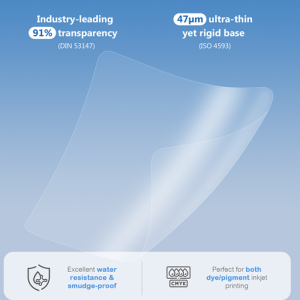
Transparent PET labels allow the underlying container or packaging color to remain visible through the label material.
They can be considered for minimalist packaging, clear containers, and designs where a see-through appearance is part of the visual concept.
A-SUB lists two inkjet transparent PET options:
- Y80HT-WD: Transparent PET, 80μm surface thickness, water glue.
- Y47HT-WD: High Transparent PET, 47μm surface thickness, water glue.
The thinner high-transparent option and the standard transparent option should be evaluated through actual print samples and application tests before selecting a model for a specific packaging project.
Glossy White PET Labels
Glossy white PET provides a white label background with a glossy surface. This option can be considered when a packaging design requires a white base rather than a transparent appearance.
A-SUB’s listed model is Y80GT-WC: Glossy White PET, 80μm surface thickness, water glue.
Metallic PET Labels
Metallic PET labels offer a reflective surface that can add a more distinctive appearance to packaging.
A-SUB’s inkjet PET range includes several metallic finishes:
- Matte Silver PET – Y80MTYY-WC
- Glossy Silver PET – Y80GTLY-WC
- Brushed Silver PET – Y80GTLSY-WC
- Matte Golden PET – Y80MTYJ-WC
- HD Glossy Golden PET – Y70GTLJ-WC
- Brushed Golden PET – Y80GTLSJ-WC
These options allow buyers to compare different metallic appearances when developing packaging label collections.
Decorative Textured PET Labels
A-SUB also lists decorative PET finishes, including laser-surface, spiral, snowflake, mix texture, and starry PET. These materials can help label distributors and printing businesses expand their product portfolios with more visual variety.
The actual appearance of each finish should be checked using physical samples, especially when the final packaging design depends on a specific reflective or textured effect.
3. Why Does PET Label Thickness Matter?
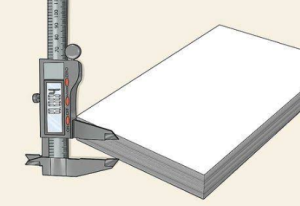
PET label thickness is another important specification for bulk buyers.
A-SUB’s listed inkjet PET label models include surface thicknesses of 47μm, 70μm, and 80μm. These figures refer to the PET surface thickness shown on the product page, not necessarily the total thickness of the complete label construction.
When comparing different models, buyers should consider whether the selected thickness matches the intended labeling process, printer requirements, handling needs, and finished appearance.
It is important to distinguish surface thickness from total label thickness. The adhesive and release liner contribute to the complete construction. For accurate purchasing decisions, request the full technical specification rather than comparing products using facestock thickness alone.
4. Are Inkjet PET Labels and Laser PET Labels Interchangeable?
No. Printer compatibility should be confirmed before purchasing.
Although both products use PET film as the facestock, inkjet and laser printing involve different printing processes. A label designed for one process should not automatically be treated as suitable for the other.
Inkjet Vinyl Labels (PET)
- Transparent PET – Y80HT-WD
- Glossy White PET – Y80GT-WC
- Glossy Silver PET – Y80GTLY-WC
- Matte Golden PET – Y80MTYJ-WC
Laser Vinyl Labels (PET)
- Matte PET – YL50MT-WD
- Transparent PET – YL50TT-WD
- Glossy PET – YL50GT-WD
Before ordering, buyers should confirm the exact printer technology and model supported by the selected SKU. They should also check the recommended printer settings, media thickness range, and feeding requirements.
5. What Should Buyers Check Before Ordering PET Labels in Bulk?
1. Printer Compatibility
Confirm whether the product is designed for inkjet or laser printing. If customers use different printer brands and models, test samples on representative equipment.
2. Surface Finish
Compare the actual appearance of transparent, white, metallic, and textured options. Product photographs may not fully show the reflective characteristics of a material.
3. Material Thickness
Check whether the specified thickness refers to the facestock or the complete label construction. This distinction matters when comparing suppliers.
4. Adhesive and Release Liner
A-SUB’s listed PET label models specify water glue. Buyers should still request more detailed adhesive information, including suitability for the intended substrate and application conditions.
5. Application Requirements
The label’s performance depends not only on the material but also on the surface receiving it. Test the label on the actual packaging material and evaluate application, adhesion, and handling under the intended conditions.
6. Supply and Customization
For wholesalers and distributors, stable specifications, clear SKU identification, sample availability, and practical order terms are important parts of supplier evaluation.
6. How Can PET Labels Expand a Label Distributor’s Product Portfolio?
Offering only one type of label material may limit the customers a distributor can serve.
Different packaging projects may require different visual effects. A customer producing transparent bottles may prefer clear PET labels, while another developing premium-looking packaging may be interested in metallic or textured finishes.
| Label Type | Visual Characteristics | Potential Applications |
|---|---|---|
| Transparent PET | See-through appearance | Clear-container packaging |
| Glossy White PET | White glossy surface | General product packaging |
| Matte Silver PET | Subtle metallic appearance | Distinctive packaging designs |
| Glossy Silver PET | Reflective silver finish | Decorative product labels |
| Golden PET | Gold-toned appearance | Premium-style packaging |
| Brushed PET | Brushed surface texture | Industrial or decorative labeling |
| Starry / Snowflake PET | Decorative surface effects | Special-edition packaging |
These are potential application directions rather than guaranteed performance claims. Final material selection should be based on the customer’s printing process, packaging substrate, and actual application tests.
7. Why Work with A-SUB for Printable PET Labels?
A-SUB offers a range of self-adhesive inkjet sticker and vinyl label materials, including paper, PP, and PET options.
Its listed PET label selection covers transparent, glossy white, silver, golden, and decorative finishes, with different surface thicknesses and adhesive specifications.
For buyers developing a label product portfolio, this range provides several material and appearance options to evaluate.
Explore A-SUB Stickers & Labels
For additional product information and purchasing discussions, buyers can contact A-SUB to confirm available PET label models, printer compatibility, adhesive and release liner details, available sizes, packaging options, sample availability, and order requirements.
Looking for a printable PET label supplier? Contact A-SUB to discuss your product requirements and identify suitable label materials for your market.
Conclusion
Choosing printable PET labels requires more than comparing surface appearance. Buyers should evaluate printer compatibility, facestock thickness, adhesive specifications, and the actual packaging application.
Transparent, white, metallic, and textured PET labels each offer different visual possibilities. By understanding these differences, wholesalers and printing businesses can build a more suitable label portfolio and make more informed purchasing decisions.
Leave a Reply